
Why the DFF?
Eastern deciduous forests stretch from northern Florida to Maine and west to the Mississippi River. Prior to the arrival of European colonists, these forests were broadly shaped by natural disturbances. In some regions, Native Peoples used fire to improve conditions for agriculture and hunting, and to promote highly valued tree species like oaks and hickories. These factors collectively created a dynamic patchwork of young forests, open woodlands, mature forests, and expansive grasslands.
Colonists continued to alter the landscape, cutting forests for settlements and small farms. Spurred by the Industrial Revolution, the United States began to grow rapidly in the mid-nineteenth century. The U.S. population tripled between 1850 and 1900, leading to vast tracts of forestland being cleared for wood to support the new economy. Forest cover reached its historical low point in the early 1900s, when railroads, steamboats, and new construction demanded the clearing of millions of acres of forestland each year.

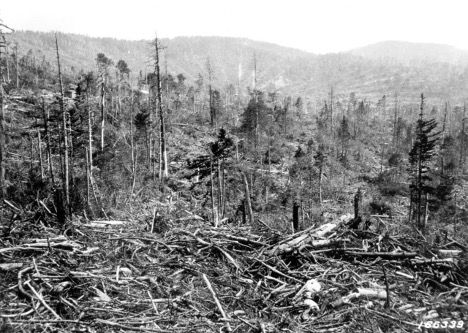
After this period of landscape-scale clearing, shifting industrial demands and the widespread abandonment of farmland allowed forests to regrow extensively, resulting in a predominance of even-aged eastern forests. Invasive species and introduced pathogens further altered the landscape, while herbivory by livestock and deer limited regrowth of forest stands. Owing largely to these past and contemporary stressors, much of today’s eastern deciduous forestland is composed of 80–120-year-old stands that lack the complexity and resilience of healthy forests.
Photo: Wikimedia Public Domain
Photo: Wikimedia Public Domain
Photo: Wikimedia Public Domain
Threats
The Deciduous Forest Framework targets three major threats to forest health in the Eastern U.S. - poor or inadequate forest management, invasive plants, and pests and diseases. With 80% of eastern deciduous forests privately owned, voluntary sustainable management by landowners is essential to improve long-term forest health.

Poor or Inadequate Management
Many forests continue to deteriorate through exploitative harvesting, such as “high-grading,” that removes only the best, most valuable trees and leaves less desirable trees behind. These unsustainable practices, along with fire suppression and too few landowners actively managing their forestland, have created forests defined by low-quality trees, a lack of vertical structure, poor regeneration, skewed and reduced tree species diversity, and declining long-term productivity.

Invasive species are introduced by humans to an area outside their native range and cause environmental or ecological harm, or threaten human health. Invasive plant species like stiltgrass, autumn olive, and kudzu are now established across roughly half of our eastern deciduous forests. They outcompete native vegetation, suppress tree regeneration, degrade wildlife habitat, and complicate harvest operations.
Invasive Plants

Insect pests, pathogens, and excessive deer browsing all threaten forest health. Some pests and pathogens have already caused the functional extinction of tree species like white ash and American chestnut, while deer overbrowsing seedlings and new growth keeps forests from regenerating in many regions. Deer can also worsen invasive plant problems by selectively eating native plants.
Pests and Diseases
Private landowners are essential to restore, steward, and sustain eastern deciduous forests. Through voluntary, proactive forest management, landowners can help ensure that these forests remain productive, healthy, and resilient for generations to come.
NRCS and the Deciduous Forest Framework support this work by providing financial assistance, expert guidance, and science-based tools and resources that help landowners meet their goals, while strengthening forest health and improving wildlife habitat.
Deciduous forests stretch across much of the Eastern United States, providing clean air and water, essential forest products, and habitat for people and for wildlife. Although these forests appear abundant and green, their health is quietly declining.
Most of today’s eastern forests regrew after heavy logging a little more than a century ago and are now dominated by even-aged stands. Dense closed canopies block the sunlight young trees need, while heavy deer browsing removes many of the seedlings that manage to sprout. As a result, too few young trees are growing to replace the old - creating a regeneration deficit that weakens forests, reduces timber quality, and increases vulnerability to pests and disease.
DFF Forestry: Strategic, Sustainable, Scalable

With science-based active management, these forests can be reinvigorated. Sustainable forestry restores a healthy mix of age classes, rebuilds structural and species diversity, improves wildlife habitat, and enhances long-term timber productivity. Restoring key tree species like oaks helps sustain forests for the wildlife and people that depend on them.
Deciduous forest management is inherently more complex than the approaches required for most other forest types. Eastern deciduous forests have layered canopies, diverse understories, and high species richness - creating a web of interactions between their plants, wildlife, and seasonal processes. This structural and ecological complexity means that managing for timber, wildlife, and overall forest health requires a more nuanced, site-specific approach than the more uniform and predictable management of other forest types. The Deciduous Forest Framework provides the guidance and support needed for this critical work.
